
In material testing, researchers often focus mainly on the testing instrument. But the accuracy of the result does not depend only on the instrument.
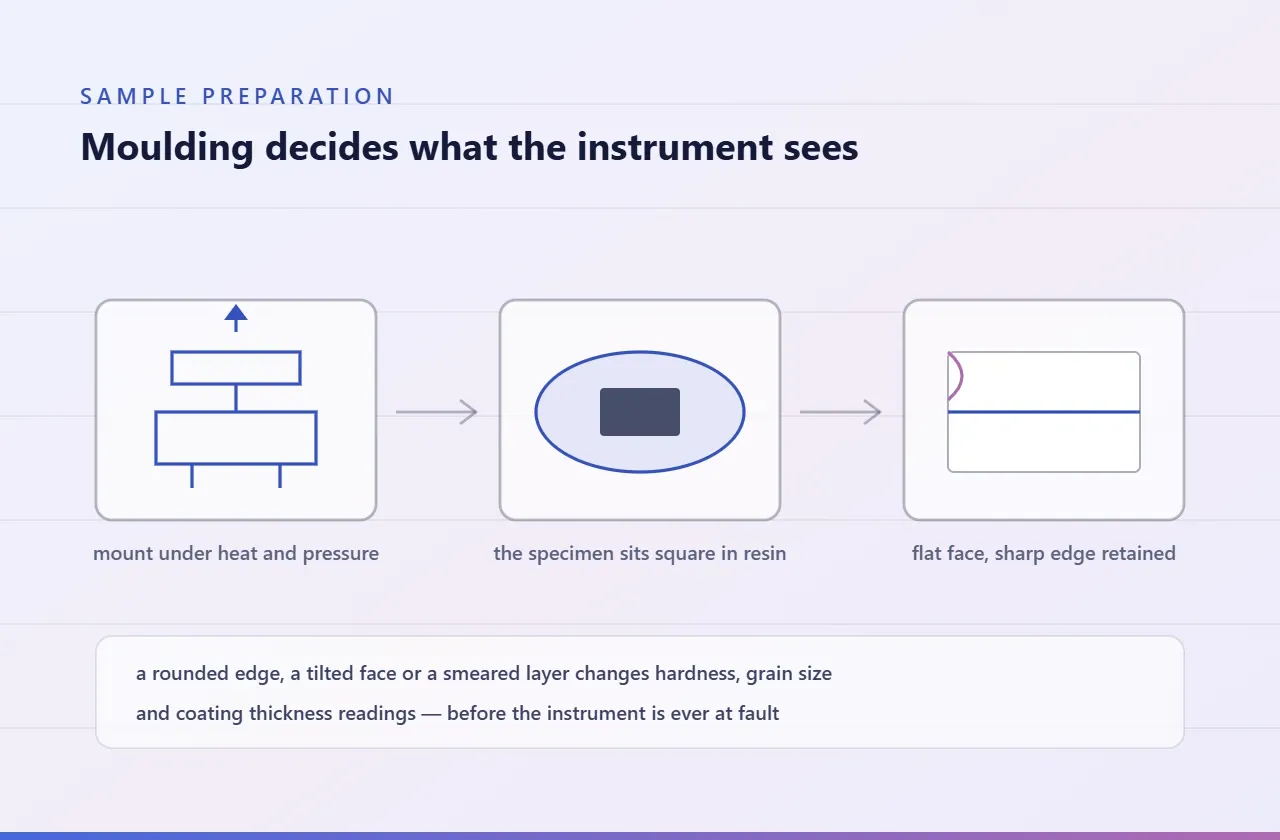
It also depends strongly on how the sample is prepared before testing.
For many materials, the raw sample cannot be tested directly. Materials such as polymers, plastics, rubbers, elastomers, composites, resins, powders, filled formulations, and newly developed lab materials often need to be converted into a proper shape before testing.
This process is called sample moulding.

What is Sample Moulding?
Sample moulding is the process of preparing a material into a defined specimen shape and size before testing.
It helps convert raw material, powder, resin, polymer, rubber, or composite formulation into a proper test-ready sample.
The moulded sample may be prepared in the form of a strip, disc, sheet, pellet, block, or standard specimen depending on the required test method.
Why is Sample Moulding Important?
Sample moulding helps prepare the sample with:
defined dimensions
uniform thickness
proper surface quality
suitable geometry
better handling during testing
This is important because many testing methods require the sample to have a specific shape and size.
For example, tensile, compression, flexural, impact, and hardness testing need proper specimen dimensions. If the sample shape is not correct, the load may not distribute properly during testing.
In such cases, the result may not represent the actual material property.
How Poor Sample Preparation Affects Results
Sometimes variation in test results happens not because the material is poor, but because the sample is not prepared properly.
Poor sample moulding can lead to:
edge defects
stress concentration
sample slipping
premature failure
poor repeatability
variation between samples
inaccurate mechanical property values
For example, in mechanical testing, an uneven edge or improper thickness can create local stress concentration. This may cause the sample to fail early, even if the material itself has good strength.
So, proper sample moulding helps reduce preparation-related errors.
Where is Sample Moulding Useful?

Sample moulding is useful before many types of testing and analysis, such as:
tensile strength testing
compression testing
flexural testing
impact testing
hardness testing
optical microscopy
SEM analysis
physical and mechanical evaluation
After moulding, further preparation steps like cutting, polishing, optical microscopy, SEM, and related analysis also become easier.
A well-prepared sample is easier to handle, easier to mount, and more suitable for accurate observation or testing.

Final Takeaway
Before testing any material, it is always important to ask:
Is my sample in the right form for this test?

Because in material testing, reliable results start with proper sample preparation.
Sample moulding helps make the sample dimensionally stable, uniform, test-ready, and suitable for the selected testing method.
At RNDgrid, we help researchers, startups, and industries with sample moulding, sample preparation, testing, and characterization support.