But before imaging, some samples need special preparation.
One common preparation step is gold coating.
What is Gold Coating?
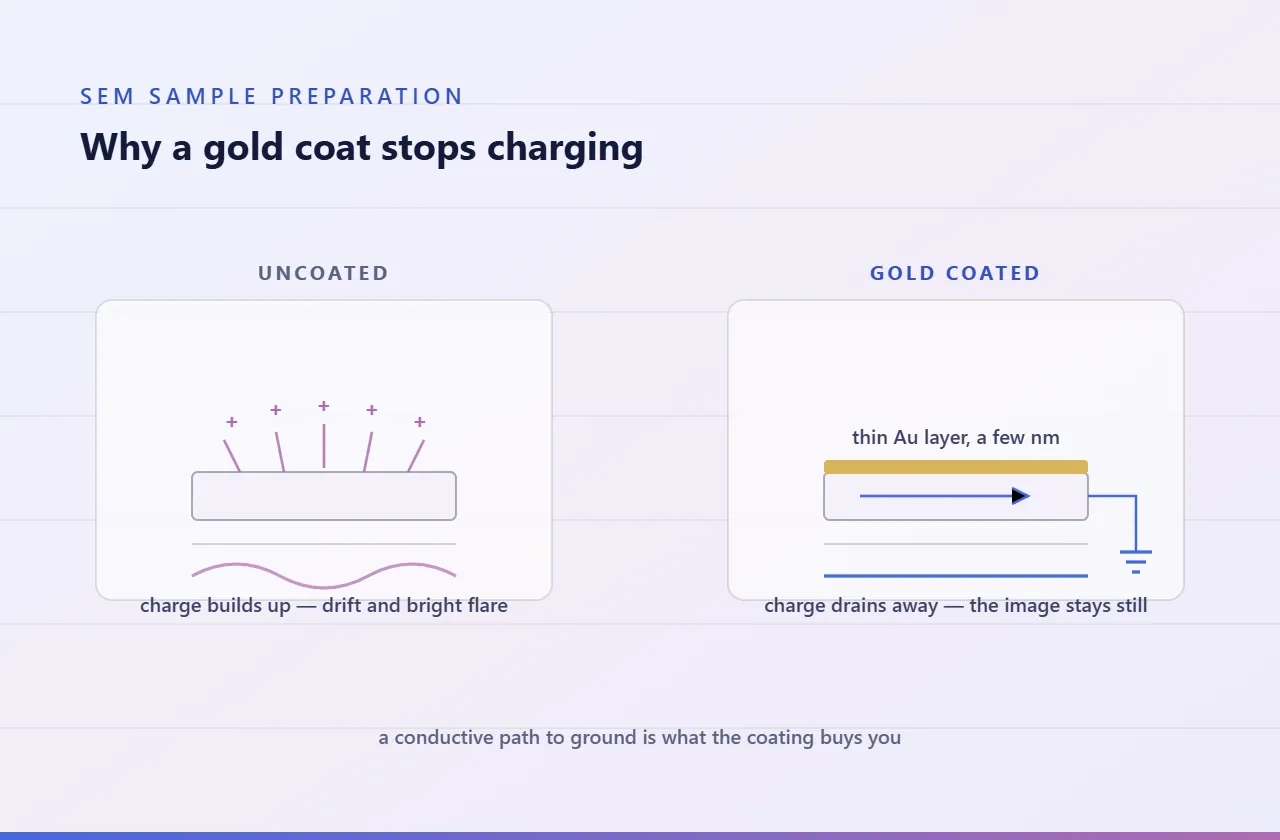
Gold coating is the process of depositing a very thin conductive layer of gold on the sample surface before SEM or FESEM imaging.
This coating is usually only a few nanometers thick, but it plays an important role in improving image quality, especially for non-conductive or poorly conductive samples.
Gold coating is mainly used for samples such as:
polymers
ceramics
powders
fibers
biological samples
insulating materials
many nanomaterials
non-conductive coatings
Why is Gold Coating Needed?
The main reason for gold coating is to reduce the charging effect.
In SEM/FESEM, an electron beam continuously strikes the sample surface. If the sample is conductive, excess electrons can flow away from the surface.
But if the sample is non-conductive, electrons cannot easily dissipate.
As a result, electrons start accumulating on the sample surface. This is called charging.
What Happens Due to Charging?
Charging can affect SEM/FESEM imaging in many ways.
It can cause:
bright spots or overexposed areas
image drift
unstable imaging
blurred or distorted morphology
poor contrast
difficulty in focusing
poor image clarity at higher magnification
unreliable surface feature observation
Because of this, the image may not represent the actual surface morphology of the sample properly.
How Gold Coating Helps
Gold is highly conductive.
When a thin gold layer is deposited on the sample surface, it creates a conductive pathway for excess electrons to dissipate.
This helps reduce charging and makes imaging more stable.
Gold coating helps improve:
image clarity
surface morphology visibility
contrast
focus stability
imaging at higher magnification
sharpness of surface features
In simple words:
Gold coating helps non-conductive samples behave more like conductive samples during SEM/FESEM imaging.
When is Gold Coating Required?
Gold coating is usually required when the sample is:
non-conductive
poorly conductive
charging during imaging
difficult to focus
giving unstable or distorted SEM images
being observed at higher magnification
It is commonly used for polymers, ceramics, powders, fibers, biological materials, and many insulating samples.
Is Gold Coating Always Suitable?
No. Gold coating is not always the best choice.
If the purpose of SEM/FESEM is only morphology observation, gold coating is often useful.
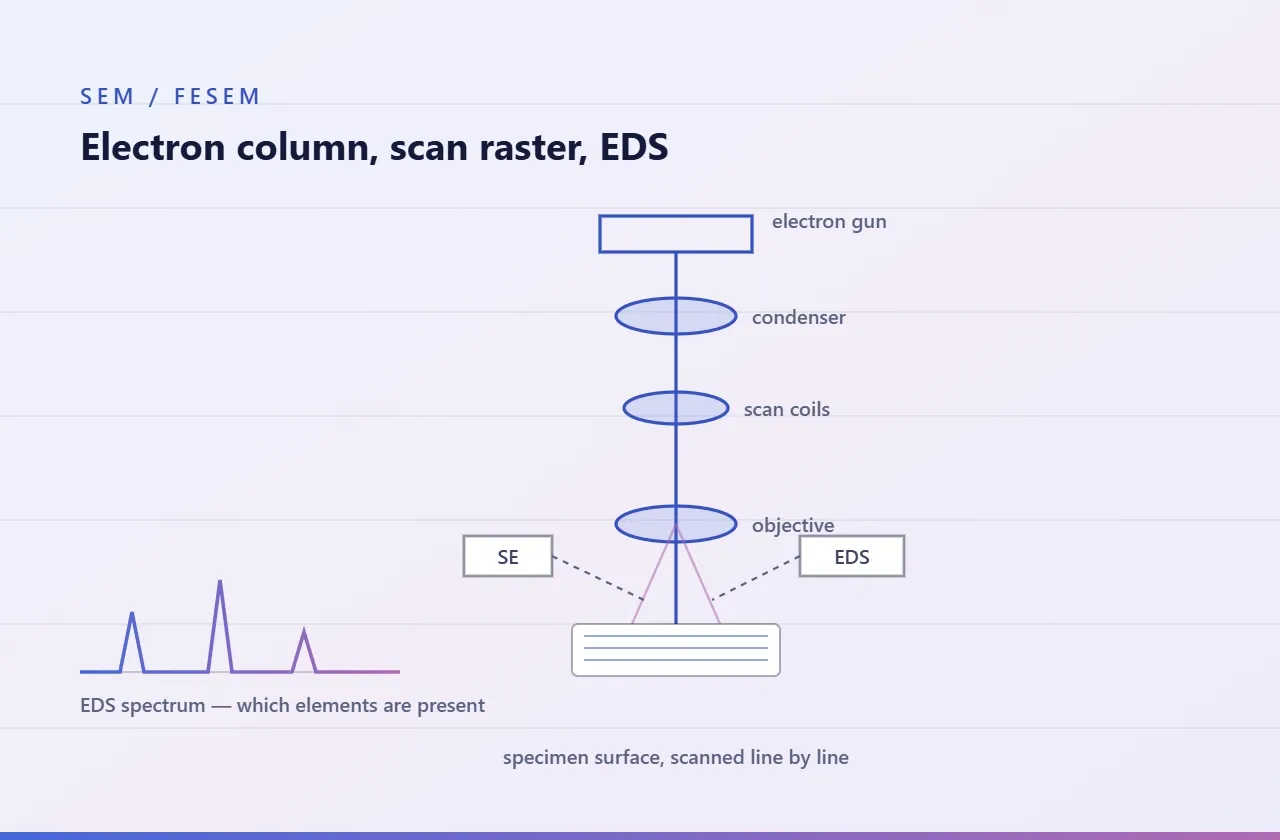
But if accurate EDS elemental analysis is required, gold coating may interfere with the elemental results because gold peaks can appear in the EDS spectrum.
In such cases, other preparation methods or coatings may be considered depending on the sample and analysis requirement.
So, the coating method should be selected based on the purpose of analysis.
Final Takeaway
Gold coating is an important sample preparation step in SEM/FESEM imaging for non-conductive or poorly conductive samples.
It helps reduce charging, improve image stability, increase contrast, and provide clearer surface morphology.
However, it should be used carefully when EDS elemental analysis is required.
In short:
Gold coating improves SEM/FESEM image quality by reducing charging in insulating samples.
At RNDgrid, we help researchers and industries choose the right sample preparation and characterization method for SEM, FESEM, XRD, BET, XPS, and more.