BET surface area analysis is commonly used to measure the specific surface area, pore volume, and pore-related properties of materials. It is widely used for powders, porous materials, catalysts, activated carbon, MOFs, zeolites, ceramics, battery materials, and many other research samples.
But before BET measurement, sample preparation is very important.
One of the most important sample preparation steps in BET analysis is degassing.
What is Degassing in BET Analysis?
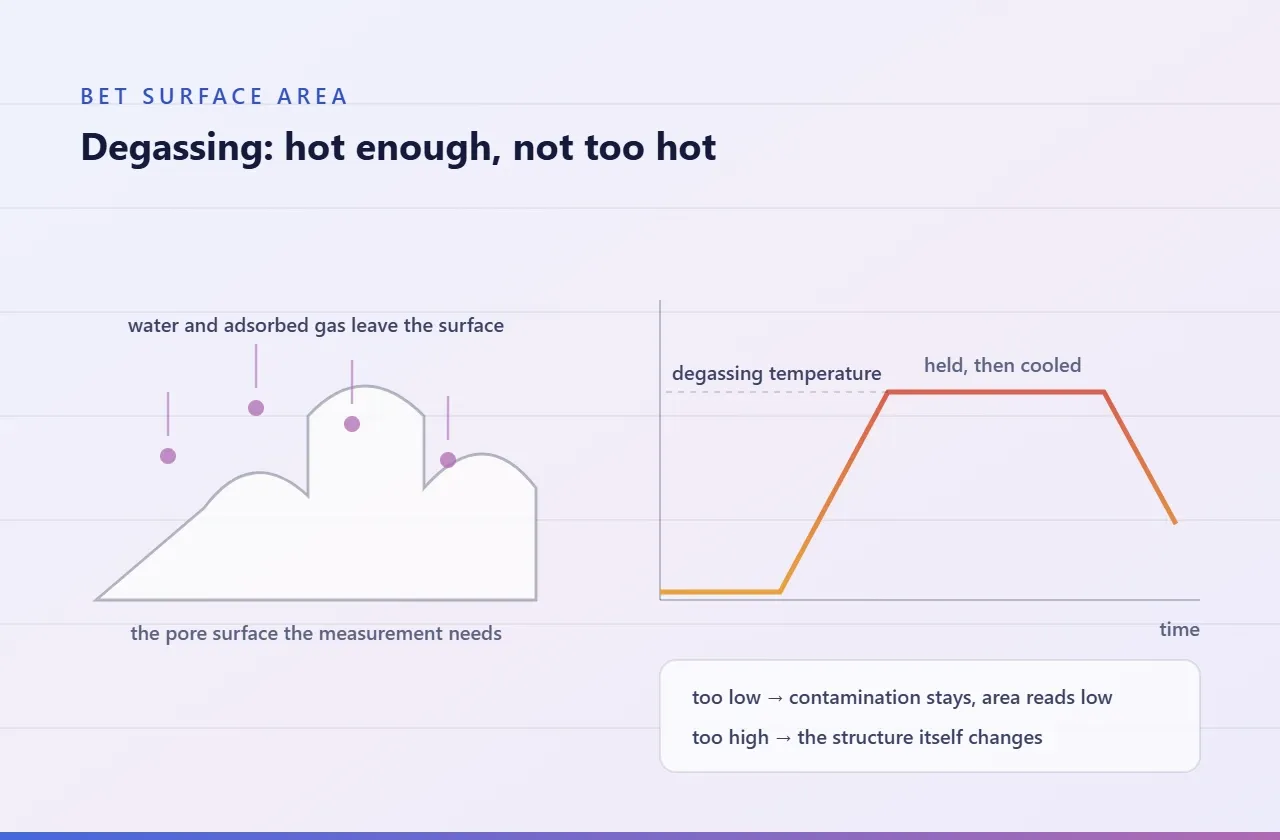
Before BET measurement, the sample is usually heated under vacuum or inert gas flow to remove unwanted molecules from the surface and pores.
This process is called degassing.
Degassing helps remove:
adsorbed moisture
trapped gases
solvent molecules
volatile impurities
weakly adsorbed surface contaminants
These molecules must be removed because BET works by gas adsorption, commonly using nitrogen gas.
If moisture, gases, or impurities are already present on the surface or inside the pores, nitrogen cannot adsorb properly during measurement.
As a result, the BET surface area and pore-related results may become inaccurate.
What is Degassing Temperature?
The degassing temperature is the temperature used during the degassing step before BET measurement.
In simple words:
Degassing temperature is the heating temperature used to clean the accessible surface and pores of the sample before gas adsorption analysis.
This temperature helps prepare the material so that the gas used in BET analysis can properly adsorb on the available surface.
Why is Degassing Temperature Important?
Degassing temperature directly affects the accuracy of BET results.
If the degassing temperature is too low, moisture and adsorbed molecules may not be removed completely.
This can reduce the accessible surface area and affect:
BET surface area
pore volume
pore size distribution
adsorption-desorption behaviour
repeatability of results
If the degassing temperature is too high, the sample may get damaged.
It may:
degrade
shrink
collapse
oxidize
lose its actual pore structure
change chemically or physically
So, degassing temperature should not be selected randomly.
Different Samples Need Different Degassing Conditions
The correct degassing temperature depends on the sample type and its thermal stability.
Thermally stable materials such as oxides, ceramics, activated carbon, and some catalysts can usually tolerate higher degassing temperatures.
But temperature-sensitive materials such as polymers, MOFs, organic materials, biological samples, and some porous frameworks may require lower degassing temperatures.
For these materials, high temperature may damage the structure or change the original porosity.
That is why sample history, previous treatment, thermal stability, and expected structure should be considered before BET analysis.
Final Takeaway
Degassing temperature is not just a small preparation step in BET analysis.
It plays an important role in getting reliable surface area, pore volume, and pore size results.
In simple words:
Degassing temperature helps prepare the real accessible surface of the material for accurate gas adsorption measurement.
Choosing the right degassing condition helps avoid wrong results and improves the reliability of BET analysis.
At RNDgrid, we ask for sample details before BET analysis so suitable degassing conditions can be selected based on the material type and testing requirement.