
X-ray Diffraction, or XRD, is one of the most commonly used techniques for studying crystalline materials.
Most researchers use XRD for phase identification. In simple peak matching, the experimental XRD peaks are compared with standard reference data to identify which crystalline phases are present in the sample.
But sometimes, simple peak matching is not enough.
When the sample contains mixed phases, overlapping peaks, peak broadening, lattice distortion, or when accurate phase percentage is required, we need a more advanced method.
This is where Rietveld refinement is used.
What is Rietveld refinement?
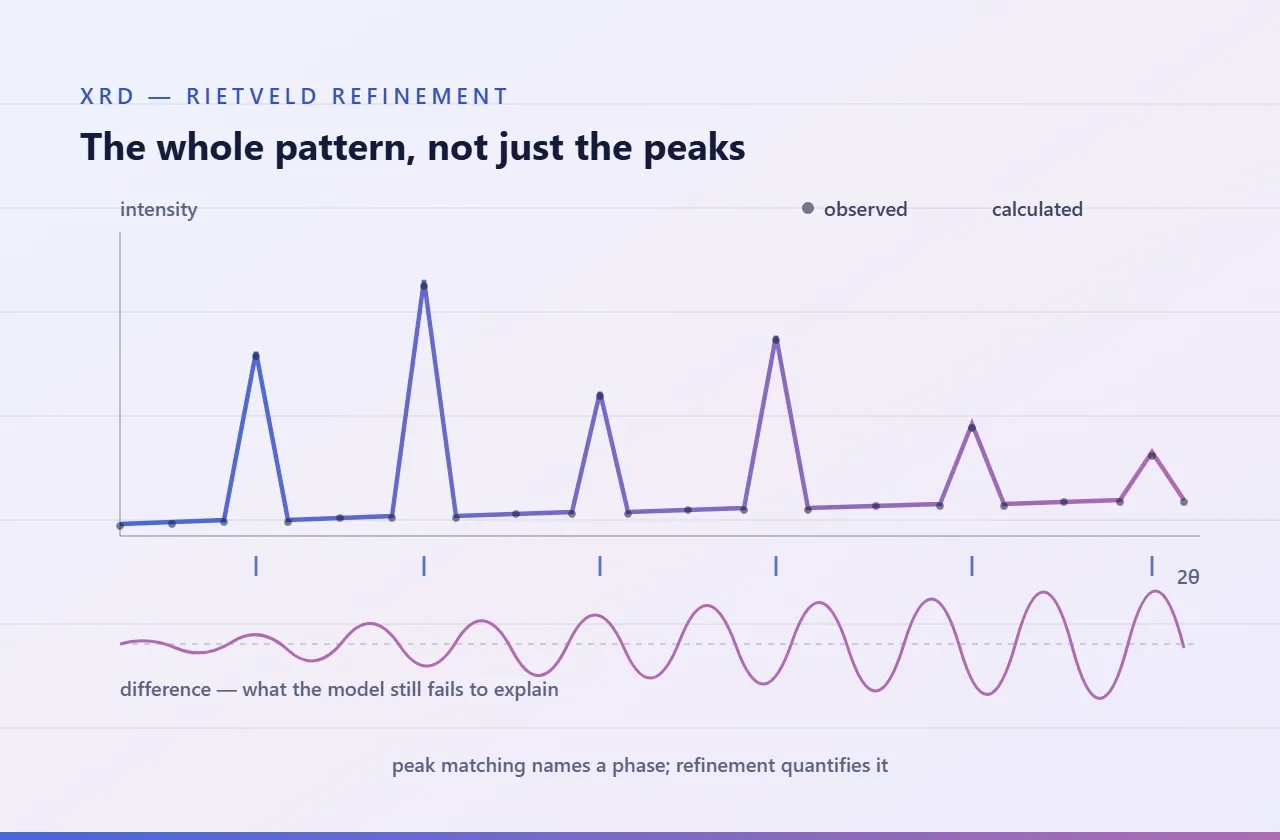
Rietveld refinement is a full-pattern fitting method used in XRD analysis.
Instead of analyzing only a few individual peaks, Rietveld refinement compares the complete experimental XRD pattern with a calculated pattern based on a crystal structure model.
The software tries to fit the calculated pattern with the experimental pattern by adjusting different structural and instrumental parameters.
In simple words:
Rietveld refinement helps match the full XRD pattern to extract more detailed structural and quantitative information.
Why is Rietveld refinement useful?
In many materials, XRD peaks may overlap or multiple phases may be present together.
Simple peak matching may only tell us which phases are present.
But Rietveld refinement can help understand the sample in more detail.
It can provide information about:
phase composition
lattice parameters
crystal structure
quantitative phase analysis
crystallite size
microstrain
peak shape and peak broadening
presence of multiple phases
This makes Rietveld refinement very useful for researchers working with ceramics, oxides, catalysts, battery materials, minerals, alloys, nanomaterials, cement materials, and crystalline powders.
Example: why peak matching may not be enough
Suppose a sample contains two crystalline phases.
Normal XRD peak matching may show that both phases are present.
But if the peaks are overlapping, it may be difficult to understand how much of each phase is present.
Rietveld refinement can help estimate the phase percentage by fitting the full XRD pattern.
For example, it may show that the sample contains:
70% Phase A and 30% Phase B
This type of information is very useful in research, product development, quality control, and publication work.
What does Rietveld refinement actually compare?
Rietveld refinement compares:
Experimental XRD pattern
with
Calculated XRD pattern from a crystal structure model
During refinement, parameters such as lattice constants, phase fraction, peak shape, background, preferred orientation, crystallite size, and strain may be adjusted to improve the fit.
The goal is to reduce the difference between the observed and calculated pattern.
When should Rietveld refinement be used?
Rietveld refinement is useful when:
peaks are overlapping
multiple phases are present
accurate phase percentage is needed
lattice parameters need to be calculated
structural changes need to be studied
peak broadening needs to be analyzed
crystallite size or microstrain information is required
full-pattern interpretation is needed instead of only peak matching
It is especially helpful when the researcher wants more than just phase identification.
Rietveld refinement vs simple peak matching
Simple peak matching helps answer:
Which phase is present?
Rietveld refinement helps answer:
Which phases are present, how much of each phase is present, and what structural changes are present?
So, Rietveld refinement gives deeper and more quantitative information compared to basic peak matching.
Important point
Rietveld refinement is powerful, but it should be done carefully.
The result depends on:
quality of XRD data
correct crystal structure model
proper background fitting
correct phase selection
peak shape fitting
sample crystallinity
instrument parameters
experience of the analyst
A poor model or wrong phase selection can lead to misleading results.
So, Rietveld refinement should always be interpreted along with material knowledge, synthesis conditions, and supporting characterization data.
Final takeaway
Rietveld refinement is not just about matching XRD peaks.
It is a full-pattern fitting method that helps convert XRD data into meaningful structural and quantitative information.
It helps researchers study phase composition, lattice parameters, crystal structure, crystallite size, microstrain, and quantitative phase analysis.
For students and researchers, understanding Rietveld refinement is very useful for thesis work, publications, material development, and advanced XRD interpretation.
At RNDgrid, we help researchers with XRD testing, phase identification, peak data, Rietveld refinement, and interpretation support.