In particle characterization, terms like zeta potential, particle size analysis, DLS, and Micron PSA are commonly used. Many times, these terms are used together, but they do not mean the same thing.
Each test gives different information about the sample. So, before selecting a test, it is important to understand what you want to measure.
What is Zeta Potential?
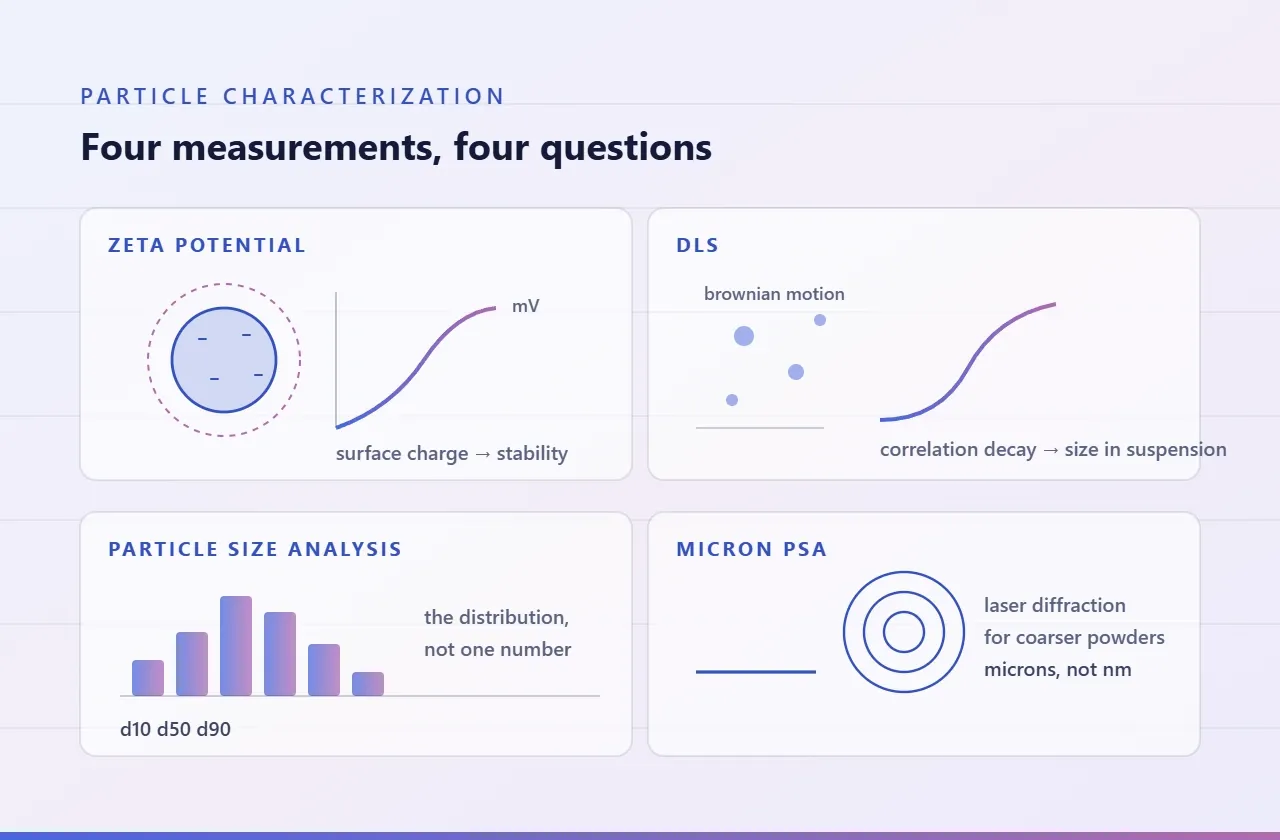
Zeta potential is used to understand the surface charge of particles in a liquid suspension.
When particles are dispersed in a liquid, they may carry a positive or negative charge on their surface. This charge affects how particles behave in the suspension.
Zeta potential helps predict whether particles will remain stable or whether they may agglomerate, settle, or form clusters.
It is usually reported in mV.
In simple words:
Zeta potential tells about particle stability in liquid.
It is useful for nanoparticles, colloids, emulsions, suspensions, pigments, polymers, and drug delivery systems.
What is Particle Size Analysis?
Particle Size Analysis is a general term used to measure how big the particles are and how they are distributed in a sample.
It helps understand:
average particle size
particle size range
size distribution
D10, D50, and D90 values
fine and coarse particle fraction
In simple words:
Particle size analysis tells the size and distribution of particles.
Different instruments may use different techniques such as DLS, laser diffraction, image analysis, or sieve analysis.
What is DLS?
DLS stands for Dynamic Light Scattering.
It is mainly used for nanoparticles and colloidal particles in liquid suspension.
DLS measures the hydrodynamic particle size. This means it measures the particle size along with the liquid layer, surface coating, or molecules attached around the particle.
That is why DLS size can sometimes be different from SEM or TEM particle size.
DLS is commonly used for nano-range samples and gives results such as:
Z-average size
PDI
particle size distribution
In simple words:
DLS is useful for nano-size particle measurement in liquid suspension.
What is Micron PSA?
Micron PSA is mainly used for micron-range particle size measurement.
Instruments such as Malvern Mastersizer 3000 use laser diffraction for particle size analysis.
In this method, particles scatter laser light at different angles. The instrument uses this scattering pattern to calculate the particle size distribution.
Micron PSA is commonly used for powders and suspensions such as ceramics, cement, soil, minerals, pigments, pharma powders, food powders, and industrial materials.
In simple words:
Micron PSA is useful for micron-size particle distribution of powders and suspensions.
Which Test Should You Choose?
Before selecting the test, ask what you want to know from the sample.
If you want to know the stability of particles in liquid, zeta potential is useful.
If you want to know the nano-size distribution in liquid suspension, DLS is useful.
If you want to know the micron-size particle distribution of powders or suspensions, Micron PSA is useful.
If you simply ask for particle size analysis, the correct method should be selected based on the sample type, expected particle size range, and testing purpose.
Final Takeaway
Zeta potential, DLS, particle size analysis, and Micron PSA are all related to particle characterization, but they answer different questions.
Zeta potential tells stability.
DLS tells nano-size in liquid.
Particle size analysis tells size distribution.
Micron PSA tells micron-range particle size distribution.
At RNDgrid, we help researchers and industries choose the right particle characterization test based on sample type, particle size range, and testing purpose.